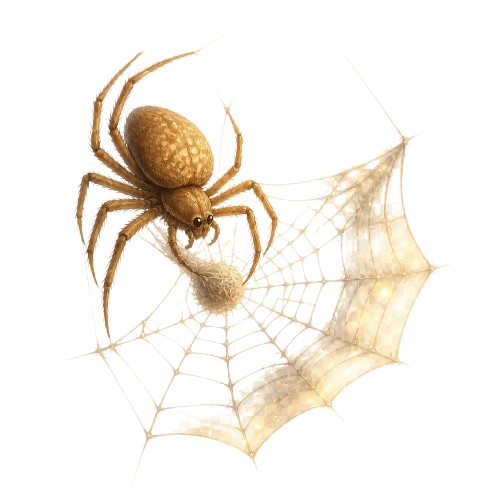
In the Natural World
Spiders are found almost everywhere: in long grass, hedgerows, woodpiles, sheds, under leaves, in corners of gardens and within the house itself. Though often overlooked, they are among the quiet workers of the living world, feeding on insects and helping keep small populations in balance.
Not all spiders spin the familiar wheel-shaped web. Some make sheet webs, tangle webs or funnel webs, while others actively hunt on foot, ambushing or stalking their prey instead. Silk may be used for catching food, wrapping eggs, building retreats, making safety lines or travelling on the wind.
A spider’s web is both delicate and practical. It may be remade, repaired or abandoned according to weather, damage and the spider’s own needs. What can look fragile in morning dew is often an example of remarkable engineering, spun from the body thread by thread.
Spider in Folklore
Spiders have long been linked with patience, weaving, craftsmanship, feminine power, luck and fate. Few creatures so clearly turn their own labour into something visible. A web spun overnight can seem almost like a sign — a quiet reminder that work, order and beauty may be made from what the body already carries.
In household folklore, spiders were sometimes treated as lucky guests and not to be harmed without cause. Their webs, especially when jewelled with dew, gave rise to associations with fine handiwork, hidden connection and the unseen structures that hold everyday life together.
Across wider European story traditions, the spider is also close to the idea of fate: the spinner, the weaver, the one who makes the pattern thread by thread. That does not mean every web is an omen, but it is easy to see why people looked at a spider’s work and saw in it lessons about persistence, design and consequences.
Spider can unsettle as easily as fascinate, and perhaps that too is part of its old meaning. It asks us to notice what we would rather ignore: the corners, the thresholds, the places where something has quietly been forming without our attention.
Through the Seasons
Spring
As the weather warms, spiders become more active in gardens, hedges and buildings. Tiny spiderlings disperse, hunting species begin to roam and webs reappear in places where winter seemed to empty the corners.
Summer
Summer brings growth and activity. Web-building spiders repair and rebuild, while hunting spiders move through vegetation and across sunlit walls. There is often far more spider life around us than we realise, simply because it is so well hidden.
Autumn
This is the season when many people notice spiders most. Orb webs show clearly in morning mist and dew, and some species may wander into houses as the weather cools. Autumn reveals the spider’s work in a way few other times of year do.
Winter
Some spiders remain active in sheltered places, while others survive as eggs or in quieter life stages. Indoors, cellars, lofts, sheds and cupboards may still hold small signs of their hidden presence.
Making Space for Spiders
Spiders do not usually ask for much: shelter, insects to feed on, and places left undisturbed for long enough to live out their lives. Yet the habit of over-tidying, frequent spraying and clearing every wild edge can leave little room for them and the wider web of invertebrate life they belong to.
Leaving a patch of the garden wilder, keeping hedge bases, allowing leaf litter to gather in places and resisting the urge to clear every web straight away can all help support this overlooked part of the living household.
A Gentle Reflection
Spider does not rush its weaving. It anchors one line, then another, building strength from connection. What looks slight in one strand becomes durable once the pattern begins to hold.
What are you quietly weaving in your own life — one thread at a time — that may be stronger than you think?
Buglife · RHS on garden spiders