In the Natural World
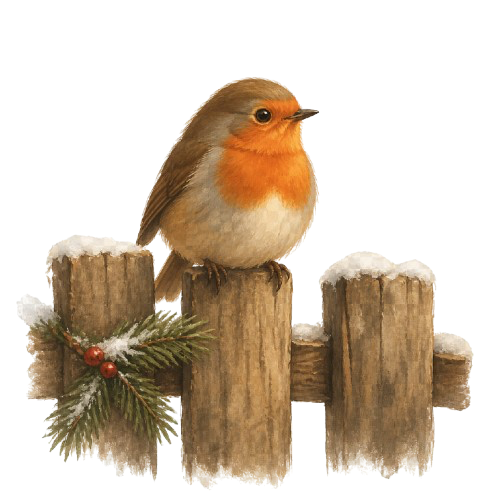
The European robin is one of Britain’s most recognisable birds. Adults have the familiar orange-red breast and face, with a brown back and pale underside. Young robins look quite different, wearing mottled brown plumage before their red breast develops.
Robins feed mainly on insects, spiders, worms and other small invertebrates, although berries, seeds and suitable garden food are also eaten. Their habit of following gardeners is practical rather than sentimental: freshly disturbed soil may reveal an easy meal.
Their friendly appearance can be deceptive. Robins are strongly territorial birds and may vigorously defend an area from another robin. The same red breast that makes them so charming to us acts as an important visual signal to rivals.
Robin in Folklore
Few British birds are surrounded by as much affection and storytelling as the robin. Its habit of appearing close to homes and gardens, and its bright breast against the bare landscape of winter, have made it a familiar companion for generations.
Old Christian legends tried to explain the robin’s red breast. In different versions, a small brown bird either drew close to Christ on the cross or attempted to soften the flames of a fire. Its breast was stained or scorched red as a mark of compassion. These are legends rather than natural history, but they helped strengthen the robin’s association with kindness and devotion.
Robin also became firmly linked with Christmas. Victorian cards frequently featured the bird, and one popular explanation connects this with Victorian postmen, whose red uniforms earned them the nickname “robins”. Whether or not that alone created the tradition, the little red-breasted bird soon became inseparable from British winter imagery.
In more recent years, another comforting saying has become widespread: “Robins appear when loved ones are near.” It is best understood as a modern piece of remembrance folklore, rather than an ancient belief.
For many people who are grieving, however, its age matters far less than the comfort it provides. A robin arriving unexpectedly may become a private moment of connection, memory or reassurance.
Through the Seasons
Spring
Spring brings nesting and intense territorial activity. Robins may choose surprisingly close-to-home nesting places, including sheds, pots, shelves and ivy-covered walls.
Summer
Adults are busy feeding young and searching for abundant invertebrate food. Newly fledged robins lack the familiar red breast and appear speckled brown.
Autumn
Territories are established again as the year turns. Robin song becomes part of the quieter autumn landscape, sometimes sounding softer and more wistful than its spring song.
Winter
The robin becomes especially noticeable during winter, when bare branches and muted colours make the red-orange breast stand out. Unlike many birds, robins may continue singing throughout the colder months.
A Bird Beside the Door
Robins have an extraordinary ability to make themselves feel almost like members of the household. One may wait beside a gardener, appear on the fence at the same time each morning, or quietly investigate the shed whenever the door is opened.
Yet familiarity should not make us forget that Robin remains entirely wild. The best garden for a robin is one rich in shelter, insects, natural food and safe nesting places.
Robin does not need to be tamed to become familiar. Given enough time, a wild bird may simply decide that your presence is part of the landscape — and that is rather special all by itself.
A Gentle Reflection
Robin is small, but it does not behave as though smallness requires silence.
It sings through winter, guards what matters to it and appears boldly in spaces occupied by creatures many times its size.
There are moments for softness and moments for standing firmly at the edge of our own little patch of ground.
Where might you need to trust your own voice a little more?
Natural-history information has been kept separate from folklore, legend and reflective interpretation throughout this page.