In the Natural World
The Eurasian magpie belongs to the crow family, alongside ravens, rooks, jackdaws and jays. Like many corvids, it is remarkably intelligent, adaptable and curious.
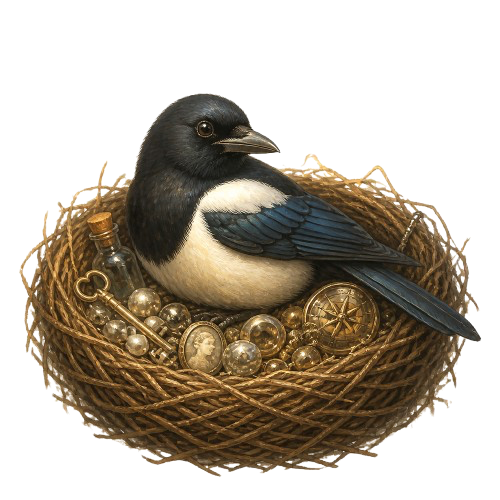
From a distance its plumage appears simply black and white, but closer inspection reveals something much more beautiful. The dark wings and tail can shine with iridescent greens, blues and purples as the angle of the light changes.
Magpies eat a wide range of foods, including insects, seeds, fruit, small animals, carrion and scraps. Their adaptability allows them to live successfully in farmland, woodland edges, parks, gardens and towns.
They are also highly observant. A magpie may spend several moments watching something unfamiliar before deciding whether it is useful, harmless or best avoided.
Magpie in Folklore
Few British birds have accumulated such a complicated reputation. Magpies have been treated as lucky, unlucky, mischievous, prophetic and suspicious — sometimes all within neighbouring parts of the country.
Perhaps the best-known tradition is the counting rhyme, in which the number of magpies seen supposedly foretells what is to come. There have been many regional versions, and the verses have changed considerably over time.
One for sorrow,
Two for joy,
Three for a girl,
Four for a boy,
Five for silver,
Six for gold,
Seven for a secret
Never to be told.
The sight of a lone magpie became especially associated with bad luck. This led to customs intended to prevent it: greeting the bird, saluting it or politely enquiring after its family.
The exact words vary, but the wonderful thing about the custom is its persistence. Even people who insist they are not remotely superstitious can find themselves automatically saying hello to a solitary magpie.
Magpies have also been accused of stealing jewellery and other shiny objects. It is a wonderfully dramatic reputation, but the familiar image of the compulsive jewel thief is much stronger in story and popular culture than in the behaviour of real birds.
Their actual curiosity is more interesting. Magpie watches, investigates and remembers. Perhaps that intelligence itself helped create the old feeling that this was a bird that knew rather more than it was letting on.
Through the Seasons
Spring
Pairs become busy around their nesting territory. Large stick nests may become conspicuous before leaves fully return to the trees, and adults work steadily on construction, repair and defence.
Summer
Young magpies leave the nest and begin learning the complicated business of finding food, avoiding danger and navigating the social world around them.
Autumn
Family groups and younger birds may be particularly noticeable. Magpies take advantage of seasonal fruit, seeds, insects and whatever other opportunities the landscape offers.
Winter
Bare trees make magpies especially visible. Their long tails and sharp black-and-white shapes stand out against pale fields, winter skies and leafless branches.
Truth, Superstition & Reputation
The magpie has often been judged according to what people believe it represents rather than what the bird actually does. That makes it a particularly interesting example of the difference between folklore and natural history.
Folklore does not have to be literally true to be worth keeping. We can enjoy saluting a magpie, remember the old rhyme and smile at stories of stolen silver — while still allowing the real bird to be far more complicated than its reputation.
A Gentle Reflection
Magpie is judged before it has done anything at all. One bird brings sorrow. Two bring joy. A curious glance becomes evidence of thieving intentions.
Yet stand close enough in good light and even its colour turns out not to be what you first thought. Black becomes green, blue and violet.
There is often more beneath the surface than the story we were first given.
Is there something — or someone — you might see differently if you looked beyond the reputation?
Natural-history information has been kept separate from folklore, superstition and reflective interpretation throughout this page.