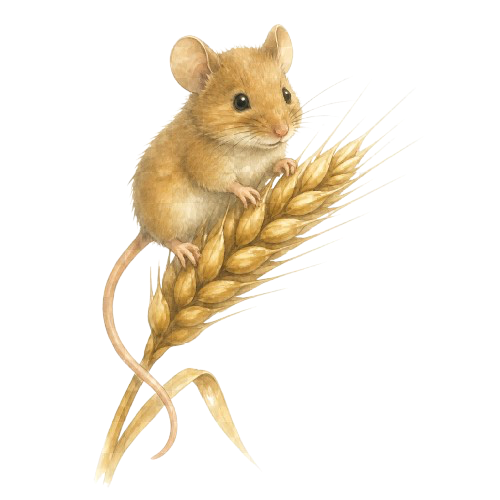
In the Natural World
Britain is home to several species that we casually call mice. The wood mouse is widespread in woodland, hedgerows, gardens and farmland, while other species occupy their own particular habitats and niches.
Small size does not mean a small appetite for exploration. Mice spend much of their active time searching for seeds, fruits and invertebrates, often travelling beneath vegetation and along well-used hidden routes.
Their senses are suited to a world in which danger may arrive from almost any direction. Large ears detect faint sounds, sensitive whiskers help them judge nearby objects and spaces, and quick movements allow them to vanish into cover remarkably fast.
Mouse in Folklore
The mouse has occupied an unusual place in folklore: tiny and easily overlooked, yet repeatedly credited with intelligence, persistence and the ability to accomplish what much larger creatures cannot.
Old stories often turn the difference in size into the heart of the tale. A mouse may escape through a gap that traps a larger animal, discover something hidden from everyone else, or repay kindness in a way nobody expected.
In fables, mice frequently remind the proud that usefulness cannot be measured by strength alone. The smallest character may notice the loose thread, gnaw through the rope or find the narrow passage that changes everything.
The house mouse gathered another kind of reputation. Because mice lived so closely alongside people — particularly where grain and stored food were kept — their sudden appearance could be woven into household signs, omens and superstitions. Different places interpreted those encounters in very different ways.
Beneath all those stories lies one enduring observation: Mouse survives by paying extraordinary attention to the world immediately around it.
Through the Seasons
Spring
Increasing warmth and new plant growth bring greater activity. Breeding begins for many small mammals and nests may be hidden deep inside banks, roots and thick vegetation.
Summer
Long vegetation creates a miniature landscape of tunnels and covered pathways. Seeds, insects and other food become increasingly plentiful.
Autumn
Nuts, berries and fallen seeds provide abundant food. Mice may gather and store some of this harvest in hidden places, making use of the season while it lasts.
Winter
Mice do not simply disappear when winter arrives. They seek shelter from harsh weather and continue feeding, relying upon stored food and whatever remains available in the surrounding landscape.
Small Lives, Hidden Worlds
It is easy to think of the smallest mammals as background characters in the countryside. In reality, they sit at the centre of a complicated web of relationships.
Mice consume seeds and insects, move plant material around the landscape and provide food for many of Britain’s familiar predators. Owl, fox, stoat and other hunters all depend, in part, upon healthy populations of small mammals.
When we protect hedgerows, rough field margins, woodland floors and quiet corners, we are protecting far more than the plants we can easily see. Whole worlds live beneath them.
A Gentle Reflection
Mouse survives without being the largest, loudest or strongest creature in the woodland.
It notices small openings, makes use of what is available and keeps moving through pathways that others may never see.
Sometimes we become so focused upon the enormous task in front of us that we overlook the tiny opening at its edge.
What small possibility might be worth noticing today?
Natural-history information has been kept separate from folklore and reflective interpretation throughout this page.