In the Natural World
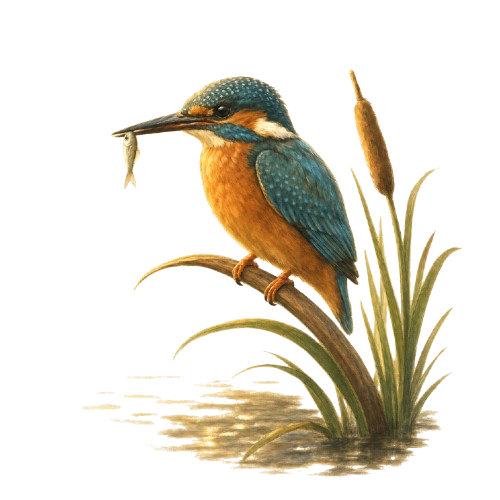
The kingfisher is one of Britain’s most striking birds, known for its brilliant blue upperparts and rich orange underparts. Though small, it is bold in colour and perfectly adapted to life beside slow rivers, streams, canals, lakes and ponds with suitable banks and clear or gently moving water.
Kingfishers hunt mainly by watching from a perch, then plunging rapidly into the water to catch small fish. They may also take aquatic insects, tadpoles and other small prey. Their short tail, compact body, long bill and swift direct flight all suit this way of life.
They nest in burrows dug into earth banks, often close to the water. A kingfisher’s presence usually suggests a habitat that still offers perches, prey and places to breed — though these birds can be easily missed unless their sudden streak of colour gives them away.
Kingfisher in Folklore
Though not as heavy with folklore as owl, raven or fox, the kingfisher carries a quiet symbolic power of its own. It has often been associated with stillness, clear sight, good fortune, peace upon the waters and the rare gift of perfect timing.
Older European traditions sometimes linked the kingfisher with calm seas or tranquil weather, part of the wider body of lore that gave rise to the phrase “halcyon days.” In that sense, the bird became a symbol of peace in the midst of uncertainty — a bright sign that calm could exist even in a world prone to shifting currents.
Its brilliant colouring has also helped it feel almost enchanted. A glimpse of kingfisher can seem less like an ordinary sighting and more like a brief visitation: a flash of blue that belongs as much to story as to stream. Because it appears so suddenly and vanishes so quickly, it has often been read as a reminder to stay attentive to fleeting gifts.
At its gentlest, Kingfisher speaks of patience before action: watch closely, wait for the right moment, then move with confidence and precision.
Through the Seasons
Spring
Spring is a lively season by the water. Kingfishers pair, defend territory and nest, and the bankside begins to hum with the life that supports them. Bright flights along the river may become more noticeable as the year opens.
Summer
In summer, adults continue to hunt and may raise broods. Young birds begin to explore their surroundings, and warm mornings beside still water can bring the best chance of a glimpse.
Autumn
Autumn light often suits the kingfisher beautifully: low sun on water, leaves beginning to turn and a sudden thread of colour flying through the edge of the season. Birds continue to fish wherever water and prey remain suitable.
Winter
Winter can be difficult for kingfishers, especially during severe freezing weather when water surfaces ice over and fishing becomes harder. Open water is vital, and in milder spells a kingfisher may still be seen flashing along a ditch, stream or sheltered river edge.
Clear Water, Healthy Banks
Kingfishers depend on good freshwater habitats. They need prey-rich waters, clean enough ecosystems to support fish and aquatic life, suitable perches for hunting and earth banks where they can dig nesting burrows. When rivers and ponds are degraded, the kingfisher loses more than one part of its world at once.
Protecting rivers, ponds and wetlands helps far more than kingfishers alone. Clean water, living banks and connected habitats create room for fish, insects, amphibians, birds and people to thrive together.
A Gentle Reflection
Kingfisher waits, watches and then moves with complete certainty. It does not fling its energy everywhere. It trusts the moment when the water clears, the opportunity appears and action becomes true.
Where in your life might patience reveal the exact moment to act — bright, swift and sure?
RSPB on kingfisher · The Wildlife Trusts