In the Natural World
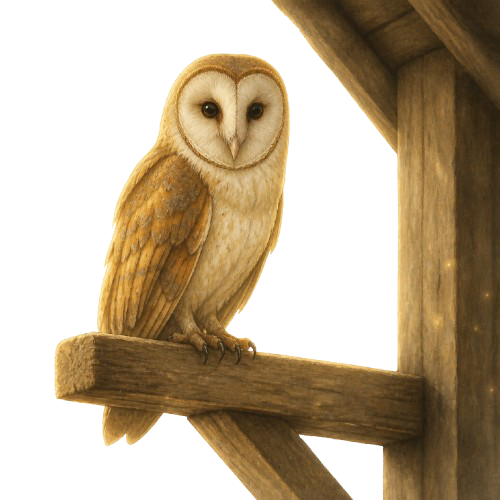
The barn owl is one of Britain’s most distinctive birds of prey, recognised by its pale plumage, long wings and heart-shaped facial disc. It is especially associated with open countryside, rough grassland, field margins, farm buildings and other places rich in small mammals.
Barn owls hunt mainly by sound. Their facial disc helps direct the faintest noises towards the ears, while their soft-edged feathers allow remarkably quiet flight. This combination lets them hunt over grassland in low light, often at dusk, dawn or during the night.
Their diet consists largely of small mammals such as field voles, mice and shrews. Rather than building a conventional nest, barn owls usually use sheltered cavities in barns, hollow trees, ruins or nest boxes where a pair can raise their young.
Barn Owl in Folklore
Owls have always gathered a deep weight of folklore around them. Their nocturnal habits, silent flight and large forward-facing eyes have linked them with wisdom, secrecy, warning, death, intuition and the unseen in different times and places.
In British folklore, owls could be viewed with both fascination and unease. A sudden cry in the darkness or a pale bird passing a window was sometimes treated as an omen, especially in communities where night sounds carried farther and darkness itself felt less familiar than it does in the modern world.
The barn owl’s ghostly colouring strengthened those associations. Seen gliding silently over a churchyard, field or old farm building, it is easy to understand why people imagined spirits, warnings or otherworldly presences where a natural hunter was simply going about its night.
Yet Owl symbolism is not only dark. The ability to see, hear and move through darkness has also made the owl a natural emblem of insight: the wisdom to notice what others miss and to remain still long enough for the hidden to reveal itself.
Through the Seasons
Spring
Spring can bring courtship, nesting and the beginning of the breeding season. Adults hunt frequently to support eggs and chicks, making good rough grassland and healthy vole populations especially important.
Summer
Young barn owls grow quickly and may begin to appear around nest sites before they are fully independent. Warm evenings can offer beautiful chances to see adults crossing open fields in the last light.
Autumn
Young birds disperse and begin finding territories of their own. Autumn fields, tussocky grass and field margins remain vital hunting places as nights lengthen and the countryside grows quieter.
Winter
Winter can be a difficult season. Cold, wet weather and snow can make hunting harder, while barn owls need to keep finding enough small mammals to survive. Sheltered roosts and good hunting habitat matter greatly at this time.
Rough Grass, Safe Roosts and Open Country
Barn owls need more than a barn. Their survival depends on connected landscapes with enough rough grassland to support healthy populations of small mammals, along with safe places to roost and breed.
Protecting rough grass margins, keeping traditional roosting spaces where possible and using wildlife-sensitive pest control can all help keep barn owls hunting across the countryside.
A Gentle Reflection
Barn Owl does not need the whole landscape to be brightly lit. It moves by subtle signs, quiet sounds and trust in finely tuned senses. Darkness does not always mean uncertainty; sometimes it asks for a different way of paying attention.
What might become clearer if you stopped forcing an answer — and listened instead for the quieter signs?
Barn Owl Trust · RSPB on barn owl