In the Natural World
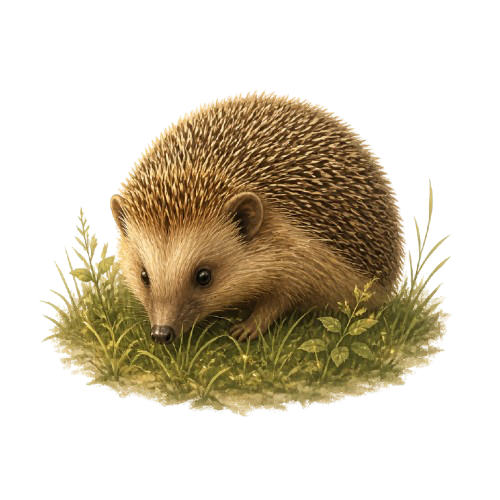
The European hedgehog is one of Britain’s most familiar mammals. Its coat of thousands of stiff spines provides its famous defence, but beneath them is a surprisingly active little animal built for long nights of searching, sniffing and wandering.
Hedgehogs are mainly nocturnal. They spend the night travelling through gardens, hedgerows, woodland edges and grassland looking for food. Beetles, caterpillars, worms and other invertebrates form an important part of their diet.
When threatened, a hedgehog can curl its body tightly into a ball, bringing the spines together around its softer face, belly and legs. It is a wonderfully effective defence against many natural predators, although sadly it offers little protection from roads and machinery.
Hedgehog in Folklore
Hedgehogs appear in old European stories in curious and sometimes contradictory ways. Their spiny armour, secretive night-time habits and tendency to disappear beneath hedges gave them an air of mystery far beyond their small size.
One persistent old belief claimed that hedgehogs carried fallen fruit upon their spines. Medieval illustrations sometimes showed them rolling beneath apple or grape vines and carrying the harvest away on their backs.
Real hedgehogs do no such thing, of course, but the image lasted for centuries. It linked the animal with gathering, storing and the abundance of the autumn landscape.
Less kindly traditions sometimes treated the hedgehog with suspicion, inventing tales of it stealing milk from cows or behaving as a pest. Such stories tell us more about human fears and misunderstandings than they do about the animal itself.
Today the hedgehog has taken on a very different place in British affection: a small emblem of the ordinary wildlife that shares our gardens, lanes and hedgerows.
Through the Seasons
Spring
Hedgehogs begin emerging more regularly from hibernation as temperatures rise. They need to rebuild lost body weight and may travel widely in search of food.
Summer
Long evenings and warm nights bring plenty of activity. Mating, nesting and raising young all take place during the warmer part of the year.
Autumn
Autumn is a crucial season of feeding. Hedgehogs need sufficient body reserves before winter, and late-born young may have only a short time to gain enough weight for hibernation.
Winter
During cold weather, hedgehogs enter hibernation inside carefully constructed nests. They may wake and move between nests during milder periods, so a winter garden is not always completely quiet.
A Garden Visitor in Trouble
Hedgehogs were once extremely common across Britain, but their numbers have fallen greatly in recent decades. The reasons are complicated, involving changes in farming, gardens, roads and the way our landscapes have become divided into smaller pieces.
One of the simplest ways to help is to make our gardens a little easier to pass through. A small gap beneath a fence can reconnect several gardens into one much larger feeding area.
A Gentle Reflection
Hedgehog carries its protection with it. When danger comes, it knows how to draw inward and wait.
But it does not remain curled forever. When the moment passes, the small nose appears again, the feet begin moving and the night journey continues.
Where might you need a little protection — and where might it now be safe to uncurl and move again?
Natural-history information has been kept separate from folklore and reflective interpretation throughout this page.