In the Natural World
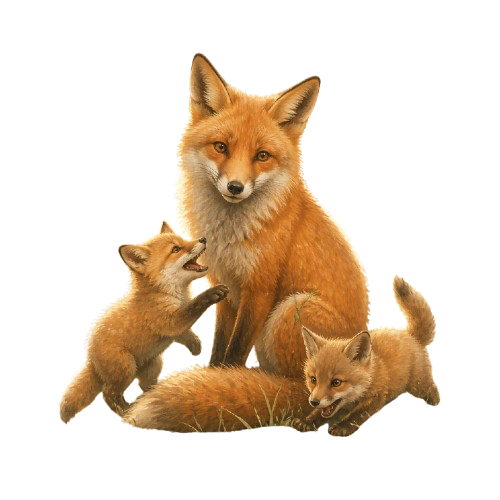
The red fox is one of Britain’s most familiar wild mammals, although much of its life passes unseen. With its reddish coat, dark legs, pointed face and great brush of a tail, it is instantly recognisable when it does step into view.
Foxes are extraordinarily adaptable. They live in woodland, farmland, coastland, hills, gardens, suburbs and even the centre of towns and cities. What they require most is somewhere to find food, enough cover to move safely and a quiet place in which to rest.
Although foxes belong to the order Carnivora, their diet is varied. Small mammals such as mice and voles are important prey, but foxes also eat rabbits, insects, worms, fruit, berries, carrion and whatever other seasonal food their surroundings provide.
Fox in Folklore
Few animals have gathered quite so many stories around themselves. Across European folklore, Fox repeatedly appears as the clever traveller: difficult to deceive, quick to notice opportunity and rarely inclined to meet strength with strength.
Medieval tales gave this character a name: Reynard the Fox. In the stories surrounding Reynard, the fox survives a world of larger and more powerful animals through wit, persuasion, deception and an impressive ability to escape the consequences of his own behaviour.
That reputation became woven deeply into language and storytelling. To be “foxy” or to “outfox” somebody still carries the idea of cleverness, strategy and finding the route that another person failed to notice.
Yet the living fox is more interesting than the simple idea of a trickster. Its success lies not merely in cunning, but in adaptability. Woodland disappears, fields change, towns expand — and Fox studies the new landscape and learns how to live within it.
Through the Seasons
Spring
Spring is the season of young foxes. Cubs remain close to the earth during their earliest weeks before gradually beginning to explore the world immediately around the den.
Summer
Growing cubs become increasingly adventurous. Much of their apparent rough-and-tumble play is practice: stalking, chasing, pouncing and learning the movements they will need as independent adults.
Autumn
Young foxes begin dispersing and searching for territories of their own. Autumn roadsides, woodland edges and field margins may briefly reveal a fox travelling through unfamiliar ground.
Winter
Winter nights carry fox voices farther than we sometimes expect. During the breeding season their calls can sound startlingly human, particularly the sharp cries often associated with vixens.
Living Beside Us
Foxes have adapted remarkably well to human landscapes. Gardens, railway embankments, parks, allotments, cemeteries and patches of scrub can together form a surprisingly useful network of feeding and resting places.
The best relationship with an urban or garden fox is often a quiet one. Allow it to remain wild. Watch from a respectful distance, remove avoidable hazards and let it continue along its own path.
A Gentle Reflection
Fox rarely insists that there is only one road forward. A blocked path becomes a reason to pause, listen, circle around and look again.
There is a difference between giving up on something and changing how we reach it.
Where in your life might another route be waiting to be noticed?
Natural-history information has been kept separate from folklore and reflective interpretation throughout this page.