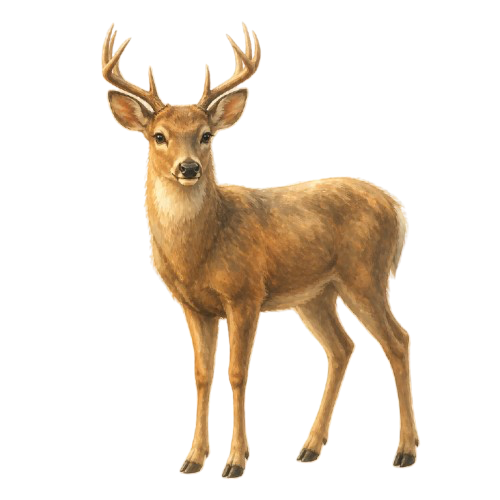
In the Natural World
Britain is home to several species of deer, from the small muntjac and roe deer to the much larger red deer. Some are native, while others were introduced at different points in Britain’s history.
Deer are herbivores, feeding on grasses, herbs, shoots, leaves, bark, buds and other plant material. Their ability to move quietly through dense woodland can make such large animals surprisingly difficult to notice until they are very close.
Their senses are finely tuned to danger. Large ears turn towards faint sounds, their sense of smell is excellent, and their wide-set eyes help them remain alert to movement around them.
Deer in Folklore
Deer have wandered through British and European stories for centuries, often appearing at the threshold between ordinary woodland and something more mysterious.
In old tales, a white hart or unusual stag may draw a hunter away from familiar roads and towards an unexpected encounter. The animal is rarely simply prey. It becomes a guide, a challenge, or a sign that the traveller is entering a place where the usual rules may no longer apply.
Stags also became strongly associated with the wild forest, sovereignty and the turning seasons. Their antlers are grown, shed and grown again, creating an easy connection with cycles of renewal and return.
The hind carries a quieter strand of folklore — watchfulness, gentleness, instinct and the ability to move carefully through uncertain ground.
These old stories do not mean that every deer encountered on a walk is carrying a supernatural message. But they do remind us how long people have stopped and paid attention when a deer suddenly appears between the trees.
Through the Seasons
Spring
Fresh plant growth provides plentiful feeding. Depending on the species, females may be preparing for young or seeking quieter places away from disturbance.
Summer
Young deer spend their earliest months learning where to feed, when to remain still and when to follow their mother into cover. Long summer growth can hide deer remarkably well.
Autumn
For several deer species, autumn is associated with the rut. Stags and bucks may become more visible, vocal and competitive as they seek mates and defend access to females.
Winter
With leaves gone and vegetation lower, deer can sometimes be easier to spot. Feeding may bring them towards woodland edges, fields and other places where food remains available.
Woodland Balance
Deer are an important part of woodland ecosystems, but the number of deer matters. Where populations become very high, repeated browsing can prevent young trees and shrubs from establishing.
This affects far more than the trees themselves. The woodland understorey provides flowers, nesting cover, food and shelter for insects, birds and many small mammals.
Caring for deer and caring for woodland are not opposing ideas. Healthy ecosystems depend upon balance: enough habitat for deer, enough natural regeneration for the woodland, and thoughtful management where those needs begin to conflict.
A Gentle Reflection
Deer does not move carelessly through the woodland. It pauses. It listens. It notices before deciding whether to stay or quietly move away.
Being alert does not have to mean living in fear. Sometimes awareness simply means giving ourselves enough time to notice what is happening before we choose our next step.
What might become clearer if you paused long enough to notice before deciding what to do?
Natural-history information has been kept separate from folklore and reflective interpretation throughout this page.