In the Natural World
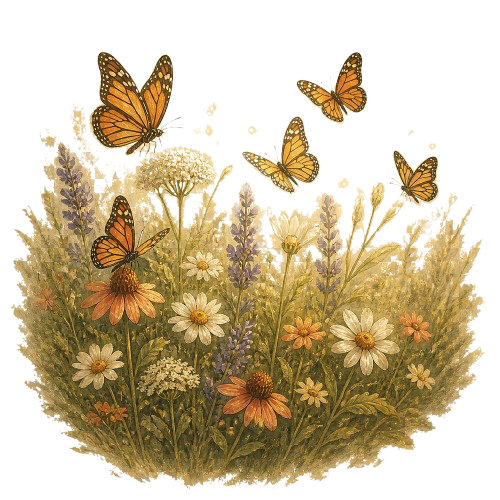
Butterflies are among the most familiar and best-loved insects in Britain. Their scaled wings catch the light in ways that make each species seem briefly luminous, whether in bright orange, rich brown, soft blue, white or sulphur yellow.
Like moths, butterflies begin life as eggs, hatch into caterpillars, form a chrysalis and finally emerge as winged adults. This complete transformation has made them powerful symbols in story and folklore, but it is also a remarkable natural process shaped by timing, temperature, food plants and safe places to rest.
Adult butterflies feed mainly on nectar, though some also take minerals from damp ground or feed on overripe fruit. Caterpillars are often far more particular, relying on specific host plants such as nettles, grasses, bird’s-foot trefoil, holly or buckthorn, depending on the species.
Butterfly in Folklore
Few creatures have gathered such strong associations with change, the soul, fleeting beauty and the turning of the seasons. Because the butterfly emerges from the chrysalis so changed in form, it has long been seen as a natural emblem of transformation and becoming.
In folk belief across Britain and Europe, butterflies were sometimes linked with spirits or souls, and their appearance could be read as a tender reminder of those no longer seen. Such beliefs were never the same everywhere, but the butterfly often carried a sense of the in-between: neither fully of the earth nor entirely apart from it.
Butterflies have also been read more simply as signs of high summer, warmth and flower abundance. A butterfly crossing the path or entering a garden may feel like a small blessing from the season itself — a bright visitor arriving with no purpose except to feed, drift and briefly delight whoever notices it.
Their fragility is part of their meaning. A butterfly cannot be hurried into being, and it cannot be kept in one place for long. It belongs to the sunlight, the hedgerow and the open hour.
Through the Seasons
Spring
The first butterflies of the year can feel like a true sign that the colder months are loosening their hold. Species that overwinter as adults may appear on the first warm days, while others emerge later as fresh adults from winter chrysalides or caterpillars.
Summer
This is the season of fullest abundance. Butterflies bask, court, feed and lay eggs. Meadows, hedgerows, woodland rides, herb gardens and patches of nettles or wildflowers can all support different kinds of butterfly life.
Autumn
Some species remain on the wing into early autumn, especially where late flowers still offer nectar. Others are already preparing for winter in one life stage or another, whether as egg, larva, chrysalis or sheltered adult.
Winter
Butterfly life becomes hidden. Chrysalides may be attached to stems, eggs remain on food plants, caterpillars shelter low in vegetation and a few adult butterflies pass the cold months in sheds, tree crevices or other quiet corners.
Making Space for Butterflies
Butterflies depend on more than pretty flowers. They need warm, connected habitats with shelter, nectar and the specific food plants that their caterpillars require. When these are lost, a place may still look green to us while becoming far less useful to butterfly life.
A butterfly-friendly space can be small: a sunny container of nectar-rich flowers, a patch of long grass, ivy left to flower, nettles allowed in a quiet corner or a less tidy edge where life can complete its cycles.
A Gentle Reflection
Butterfly begins in a form that does not resemble its ending. Much happens out of sight, and the final unfolding can seem sudden even though it has been quietly taking shape for a long while.
What in your life might be changing more gently than you realise — asking not to be rushed, but allowed to emerge?
Butterfly Conservation · UK butterflies · How you can help