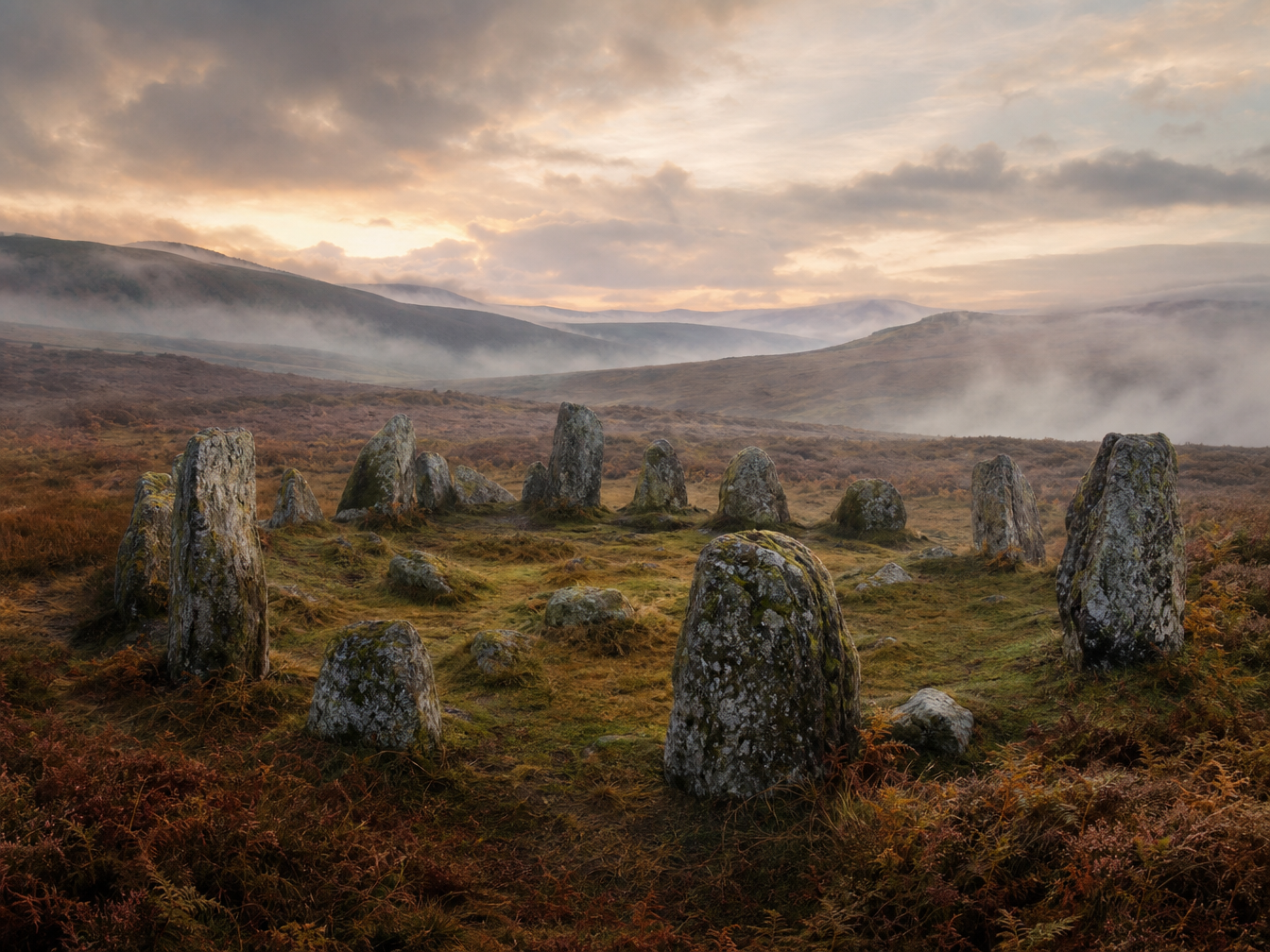
An ancient stone circle standing on misty open moorland

The Old Ways

Ancient customs, folklore and traditions carried quietly through the seasons.

Old stories live in the land, in familiar customs, in weathered places and in knowledge passed quietly from one pair of hands to another.

Not All Old Traditions Belonged to Festivals

Some lived in doorways and fields, around wells and hearths, in the way people watched the sky, listened to birds, greeted a new season or repeated a saying because somebody before them had said it too.

The old ways were never one single set of rules.

They changed from village to village, county to county, coast to countryside.

Some customs were practical. Some were superstitious. Some were protective. Some were simply habits repeated for so long that they became part of the rhythm of life.

What joins many of them together is attention β€” to place, weather, season and the things people believed mattered.

The Quiet Threads of Tradition

🌿 Ways of the Land

Before weather forecasts, supermarkets and electric light, people needed to understand the land around them.

They watched when trees came into leaf.

They noticed when certain birds arrived or disappeared.

They knew where water gathered after heavy rain, which paths became muddy first and when the ground was warm enough to work.

Not every old observation was correct, but people became observant because daily life depended upon it.

Much of this knowledge was never written down.

The land was not background. It was part of daily life.

πŸ•―οΈ Customs Without a Calendar

Not every tradition waited for a named celebration.

Some happened when the first frost came.

Some when a new loaf was baked.

Some when a person crossed a threshold, moved house, planted, harvested, travelled or returned home.

A sprig might be hung near a doorway. A candle might be lit for safe return. A coin might be kept somewhere for luck.

The first visitor of the year, the first flower, bird or storm might all be noticed.

Sometimes traditions survive simply because β€œthat is how it was always done.”

πŸͺΆ Folklore in Everyday Life

Folklore is full of signs.

A bird at the window. A horseshoe above the door. Salt spilled on the table. A robin nearby. A spider in the house. A sudden change in the wind.

People attached meanings to ordinary things because humans have always looked for patterns.

Some beliefs were warnings. Some were about luck. Some were protective. Some helped explain things that otherwise seemed mysterious.

We do not have to believe every old superstition literally to enjoy the story behind it.

Sometimes folklore means simply: people noticed this enough to keep talking about it.

πŸͺ¨ Places That Held Meaning

Certain places have always felt different.

Wells. Crossroads. Ancient trees. Bridges. Thresholds. Boundary stones. Hilltops.

Places where one thing becomes another seem particularly good at gathering stories.

A doorway is neither fully inside nor outside. A bridge joins two sides. A crossroads offers more than one direction. A well brings hidden water into the open.

These places became natural homes for customs, warnings, wishes, offerings and stories.

A place gathers stories when people keep returning to it.

πŸ’§ Water, Wells & Springs

Fresh water has always mattered.

A reliable spring or well could mean survival, so it is hardly surprising that many became places of reverence, story and custom.

Some wells became associated with healing. Some with saints. Others gathered older stories whose beginnings are now difficult to untangle.

People might visit at particular times, leave small offerings, tie cloth nearby, drink the water or simply make a wish.

Whatever meaning we give them now, these places remind us how precious clean water once was.

Where water rises from the earth, stories often rise with it.

πŸ”₯ Fire, Light & the Hearth

Fire once sat at the centre of the home.

It cooked food. Heated water. Dried clothes. Provided light. Kept cold away.

Because it mattered so much, it gathered customs around it too.

Embers were tended carefully. Candles marked important moments. Smoke was watched. Ash was sometimes kept for practical or symbolic purposes.

The hearth was practical first, but practicality and symbolism often lived side by side.

What keeps us warm easily becomes part of the stories we tell.

🧺 Knowledge Passed Quietly On

Many old ways survived because somebody showed somebody else.

Not through a textbook. Not through a formal lesson.

By watching. Helping. Repeating.

A child learned how to mend because they sat beside somebody mending.

A recipe was remembered by feel.

A plant was recognised because someone pointed it out on a walk.

A weather sign was remembered because an older person said, β€œWatch what happens when the clouds look like that.”

Knowledge survives when somebody cares enough to pass it on.

πŸ—ΊοΈ Old Ways Were Local Ways

There was never one single British folk tradition.

Coastal communities carried customs shaped by the sea.

Farming communities watched land and weather differently.

Mining areas told different stories.

One county might know a rhyme another had never heard.

One village might keep a custom the next village ignored entirely.

That local character is part of what makes folklore so interesting.

The old ways grew from particular ground.

πŸ‚ Not Everything Old Needs Keeping

The past was not automatically gentler, wiser or better.

Old communities could be harsh. Superstitions could frighten people. Customs could exclude.

There is no need to recreate hardship in order to appreciate tradition.

We can look back with affection without pretending everything was good.

We can keep the useful things. The beautiful things. The things that connect us to land, season, craft and community.

And we can leave the rest behind.

🌱 What We Carry Forward

The old ways survive whenever somebody chooses to notice.

When we learn the name of a tree.

When we remember an old saying.

When we listen to local stories.

When we mark the first frost.

When we learn a traditional craft.

When we understand that the land around us has a history.

Perhaps the old ways are not about going backwards β€” but carrying something forward.

Places Where Stories Still Cling to the Land

Across Britain there are places where archaeology, landscape and folklore sit side by side. Some are famous. Others are quieter. All offer the strange experience of standing somewhere people have been returning to for centuries β€” sometimes for thousands of years.

πŸͺ¨ Avebury

Wiltshire

Avebury is one of Britain's great Neolithic landscapes, with a vast henge and enormous stone circles spread around the modern village.

The monuments were created and altered over many centuries, leaving a landscape shaped by procession, gathering and ritual.

Unlike Stonehenge, here you can walk among the stones and experience how enormous the whole landscape really is.

🌿 West Kennet Long Barrow

Wiltshire

Built in the Neolithic period, this long chambered mound was used for burial for generations.

Visitors can still enter the stone chambers, making it one of those rare ancient places where the landscape suddenly feels very close.

Standing inside the stone chambers, it is difficult not to think about how many generations have passed through the same entrance.

β­• MΓͺn-an-Tol

West Cornwall

MΓͺn-an-Tol is one of Cornwall's most distinctive prehistoric monuments: a circular holed stone standing between upright stones on the moorland near Morvah.

Its original purpose remains uncertain, which may be one reason so much folklore has gathered around it.

Local tradition once credited passing through the holed stone with healing powers, particularly for children.

πŸŒ€ The Hurlers

Bodmin Moor, Cornwall

Three prehistoric stone circles stand in a line on the open moor near Minions.

They form part of a much wider ceremonial landscape of stones, cairns and ancient monuments.

Cornish legend says the stones are people turned to stone for playing hurling on a Sunday. Nearby standing stones known as the Pipers were said to have provided the music.

πŸ”οΈ Dartmoor's Stone Circles

Devon

Dartmoor holds stone circles, rows, cairns and standing stones scattered across its open landscape.

Some are well known, while others sit quietly among peat, heather and granite.

Places such as Scorhill and the rediscovered Sittaford circle are powerful reminders that there are still ancient stories hidden in familiar landscapes.

πŸͺ¦ Trethevy Quoit

Cornwall

Trethevy Quoit is an impressive Neolithic stone chamber formed from huge granite slabs supporting a massive capstone.

Monuments like this were associated with Britain's earliest farming communities and probably had meaning connected with ancestors as well as burial.

Its strange tilted shape gives it the feeling of something impossibly old still standing where it was meant to.

βš’οΈ Wayland's Smithy

Oxfordshire

Hidden beside the Ridgeway, Wayland's Smithy is a Neolithic long barrow whose name became linked with Wayland, the legendary smith.

One old tale says that if a traveller left a horse and a coin at the site, the unseen smith would shoe the horse while its owner was away.

πŸ‘‘ The Rollright Stones

Oxfordshire

The Rollright Stones are a group of prehistoric monuments including the King's Men stone circle, the Whispering Knights and the solitary King Stone.

Local legend tells of a king and his followers turned to stone by a witch β€” giving the stones some of the richest folklore attached to any prehistoric site in England.

🌳 Glastonbury Tor

Somerset

The Tor rises dramatically above the Somerset Levels and has gathered layers of Christian, Arthurian and older folklore.

Stories connect the hill with Avalon, King Arthur, the Holy Grail and even a hidden entrance into the otherworld.

πŸ’§ Chalice Well

Glastonbury, Somerset

Nestled beneath the Tor, Chalice Well has drawn visitors and pilgrims to its iron-rich red waters for generations.

The well has accumulated Christian, spiritual and folk traditions around its spring.

Whether visited for faith, history, quiet reflection or simply the sound of running water, it is one of those places where story and landscape have become difficult to separate.
A Quiet Thread Through Time

Traditions change. Stories change. Places change.

We change too.

But there is something comforting in knowing that people before us also watched the weather, worried about winter, welcomed spring, told stories, noticed birds, lit lamps and tried to understand the world around them.

We do not have to live as they did.

We only have to remember that some things are worth noticing.

The land.
The seasons.
The stories.
The small customs.
The knowledge passed on.

The old ways survive whenever somebody cares enough to remember.

✦ ✦ ✦