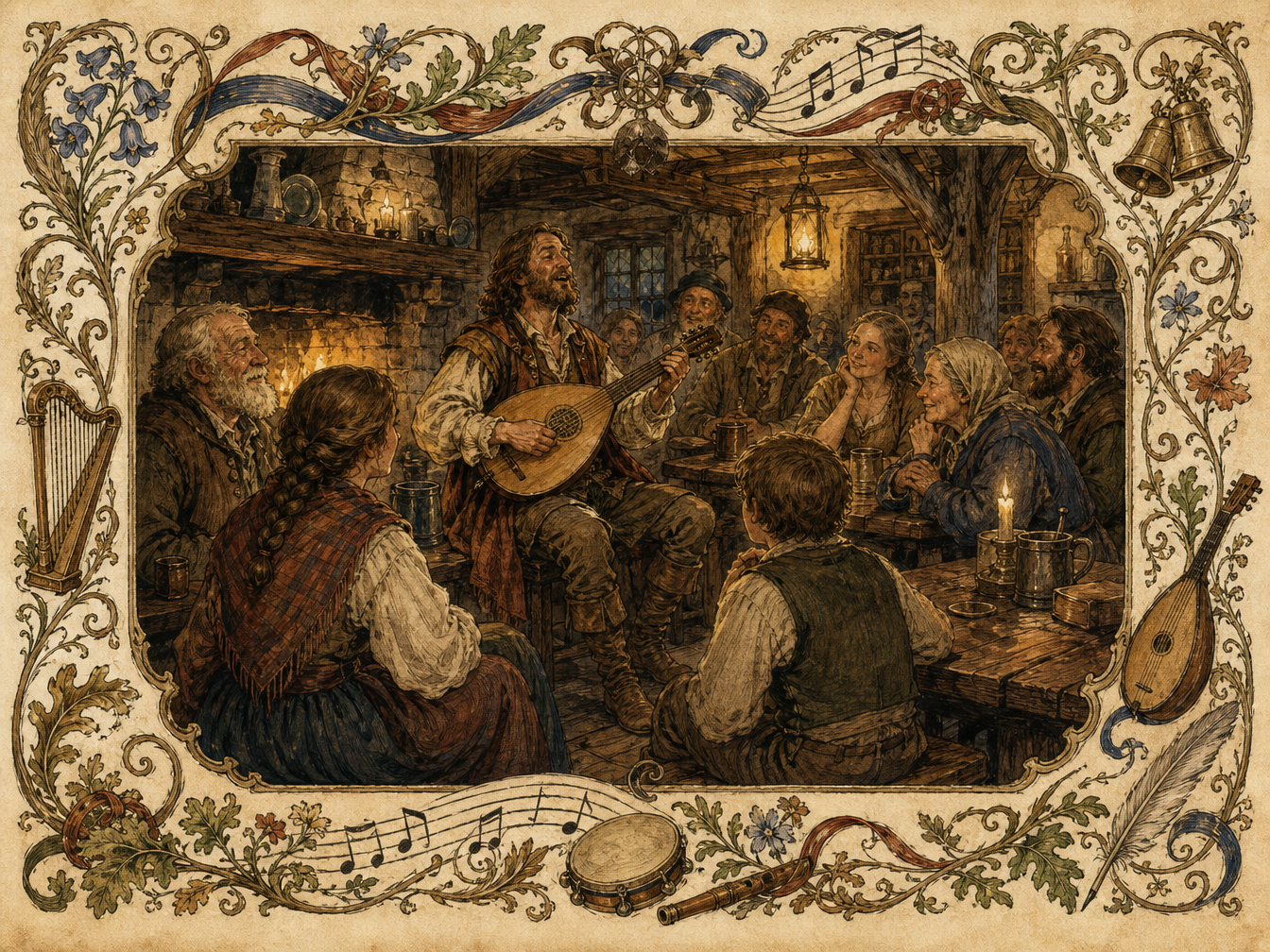
Carried by Voice
Before recordings, radio and streaming, words survived because people remembered them.
Songs were learned by ear. Rhymes were passed from child to child. Sayings were repeated at tables, in fields, on ships, in workshops and beside the fire.
Some words disappeared because the jobs, tools and ways of life they belonged to disappeared too. Others survived because they were simply too useful, too funny, too beautiful or too deeply woven into memory to be lost completely.
A voice can carry something a very long way.
Songs at Work
Not all songs were sung for entertainment.
Work could be long, repetitive and exhausting, and rhythm helped. People sang while harvesting, spinning, rowing, marching, hauling, washing, weaving and carrying out countless other jobs.
A steady beat could help people move together. A familiar chorus could make a long task feel shorter.
Sometimes the song told a story. Sometimes it was little more than rhythm and repetition.
Music could turn many separate hands into one shared movement.
Sea Shanties & Songs of the Coast
Sea shanties were working songs.
They were used aboard sailing ships to help crews coordinate heavy physical tasks such as hauling ropes, raising sails or working the capstan.
A shantyman might sing a line, and the crew would answer with a chorus at exactly the moment their effort was needed.
Different jobs called for different rhythms. Some shanties were short and sharp. Others were slower and steadier.
Not every traditional song about the sea was a shanty, though. Sailors also sang songs during their own time — of home, storms, sweethearts, distant ports, shipwrecks and the strange life of the sea.
A song made for hauling rope could eventually be sung hundreds of miles from the nearest harbour.
Songs for Gathering
People have always sung together.
At inns. At fairs. At harvest gatherings. Around fires. At family celebrations. During long evenings when entertainment had to be made rather than switched on.
Some songs had verses that could seemingly continue forever. Others invited everybody to join the chorus whether they knew the rest or not.
Sometimes belonging begins with knowing the chorus.
Children’s Rhymes & Games
Children are remarkably good at keeping old words alive.
Skipping rhymes, counting-out chants, clapping games and playground songs can pass from one generation of children to another with surprisingly little help from adults.
The words may change. Verses disappear. New ones appear. Names and places are swapped for whatever makes sense locally.
Occasionally children continue chanting words whose original meaning has been forgotten entirely. The rhyme survives because the rhythm works, because the game needs it, and because somebody teaches the next child.
A playground can be one of the oldest libraries we have.
Songs & Rhymes You May Already Know
Traditional songs and rhymes rarely have one fixed form. Words, verses and even tunes can change from place to place, so the version you know may be different from somebody else’s — and that is part of the tradition.
Sea & Work Songs
Drunken Sailor • Blow the Man Down • South Australia
Traditional Folk Songs
Scarborough Fair • The Water Is Wide • Greensleeves
Children’s Rhymes
Oranges and Lemons • Ring a Ring o’ Roses • Here We Go Round the Mulberry Bush
Old Gathering Favourites
The Wild Rover • Auld Lang Syne • John Barleycorn
Blessings, Toasts & Good Wishes
Some words were kept for particular moments.
A blessing before a journey. A toast at a wedding. A few words over a new home. A wish for good harvest. A phrase spoken when someone left or returned.
Good health.
May your fire burn warm.
May your table never be empty.
Words do not have to be elaborate to become meaningful. Repeated often enough, they become part of the moment itself.
Sayings & Old Expressions
Everyday speech is full of tiny pieces of history.
Make hay while the sun shines.
A stitch in time saves nine.
Don’t count your chickens before they’re hatched.
Many hands make light work.
Even when our lives no longer revolve around haymaking, hand sewing or keeping chickens, the meaning survives.
Old sayings last because they package an idea into something easy to remember.
A good saying is often just a whole lesson folded into one sentence.
Words That Have Drifted Away
Language changes constantly.
Some words disappear when the thing they describe disappears. Others simply fall out of fashion.
Old dialects are especially rich in words connected with weather, landscape, farming, animals and everyday work.
You may come across words that feel wonderfully specific — a name for a particular kind of rain, a muddy path, the sound of water, a difficult animal, or someone who talks too much.
And occasionally a supposedly “forgotten” word is still alive and well somewhere else.
Words rarely vanish all at once. They fade from place to place.
Dialect Belongs Somewhere
Local speech can tell you a great deal about a place.
Devon does not sound like Yorkshire. Cornwall carries words and rhythms that belong to Cornwall. Scotland, Wales, East Anglia, the West Country and countless smaller areas all have expressions shaped by their own histories.
Dialects were sometimes treated as incorrect or unsophisticated, particularly when standard English became more important in education and public life.
But dialect is not broken language.
Old occupations, landscape, migration and community can all remain hidden inside a local word.
Sometimes the way people speak is part of the landscape too.
When Nobody Knows the First Verse
Traditional songs and rhymes rarely have one perfect version.
A verse may appear in one county and disappear in another. A name changes. A place changes. A bawdy line becomes respectable.
A respectable line may become very much the opposite.
People forget parts and invent replacements.
That is not necessarily a failure of tradition. It is often how oral tradition works.
Something can change and still remain recognisably itself.
Why We Remember Them
Perhaps songs and sayings survive because they are easy to carry.
They need no equipment. No bookshelf. No electricity. No written instructions.
Only somebody who remembers and somebody willing to listen.
A tune can sit quietly in the mind for decades.
A rhyme learned at six can suddenly return at sixty.
A phrase spoken by a grandparent can appear in your own mouth years after they are gone.
Sometimes we do not realise we have inherited something until we hear ourselves passing it on.
A Few Words Worth Keeping
You do not need to become a folk-song collector or learn dozens of old dialect words.
Perhaps just notice the ones already around you.
Ask an older relative what songs they remember.
Notice sayings you use without thinking.
Listen for local words.
Learn the chorus of an old song.
Write down a phrase you do not want forgotten.
And when somebody says, “My gran always used to say…” — listen. There may be a little piece of history about to arrive.
Voices Do Not Disappear Easily
A song changes.
A word slips out of use.
A rhyme loses a verse.
Someone forgets who first taught it to them.
And still, somehow, fragments remain.
In a playground chant.
In a sailor’s song.
In a local word.
In something your grandmother used to say.
Perhaps that is the quiet strength of oral tradition.
It does not need to survive perfectly.
It only needs someone to remember enough to pass a little of it on.