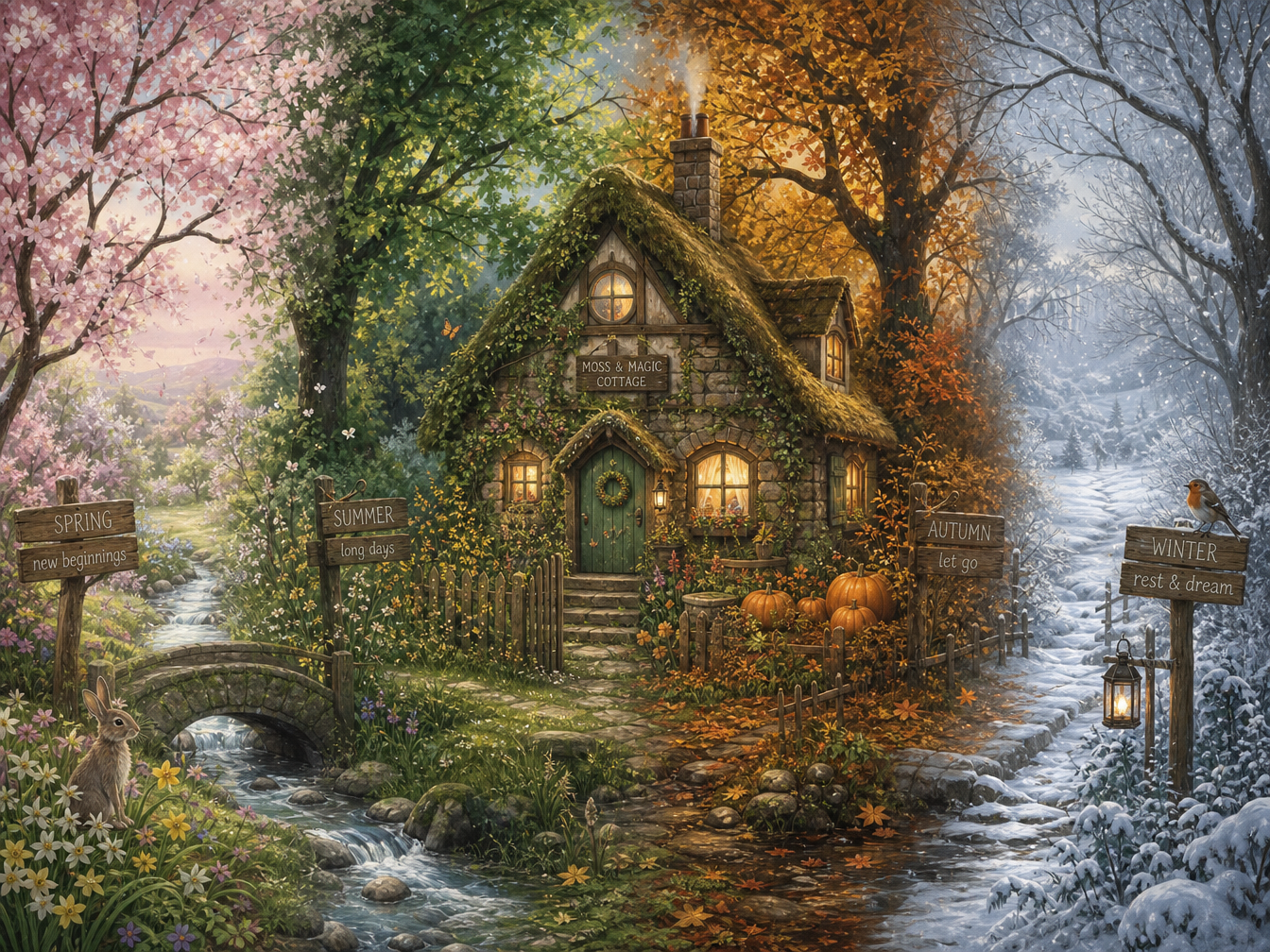
The Moss and Magic Cottage shown through spring, summer, autumn and winter

Signs of the Seasons

The year rarely changes all at once.

Blossom, birdsong, berries, frost and fading light quietly tell us when the world is beginning to turn.

The World is Always Telling Us

Spring does not arrive because the calendar says so, and autumn does not begin with the first orange leaf.

The seasons tend to announce themselves quietly β€” in birdsong, blossom, shadows, seed heads, mist and the smell of the air.

People have always watched for these changes. Some signs became old sayings and country lore; others were simply noticed because knowing what the weather and seasons were doing mattered.

You do not need to know the name of every bird or plant to notice the year turning.

Sometimes it begins with something as simple as thinking: β€œThat wasn't there last week.”

Watching the Year Turn

🌱 The First Signs of Spring

Spring often begins long before the days feel particularly warm.

Snowdrops push through cold ground. Buds swell on bare branches. Birds begin singing earlier in the morning, and evenings slowly refuse to become dark quite so quickly.

You may notice:

  • Snowdrops, crocuses and early daffodils appearing
  • Hazel catkins hanging from otherwise bare branches
  • Birds carrying twigs or nesting material
  • Frogs and frogspawn returning to ponds
  • Bees appearing on the first mild days
  • Brighter green showing in hedgerows and woodland edges

None of these means winter has completely finished with us. A bright February afternoon can still be followed by frost.

Spring often arrives first in the small things.

β˜€οΈ When Summer Begins to Settle In

There is rarely one single day when spring becomes summer.

Instead, the light stretches further into the evening. Gardens grow more quickly. Hedgerows become thick and green, and insects seem to fill the air again.

You may notice:

  • Hawthorn blossom brightening the hedges
  • Swifts, swallows or house martins returning
  • Bees moving busily between flowers
  • Elderflower appearing along lanes and paths
  • Grasses growing tall and beginning to seed
  • Warm evenings when daylight seems reluctant to leave

Traditionally, people paid close attention to flowering times, returning birds and the condition of crops because they offered clues about the growing season ahead.

Summer has a way of making the world feel suddenly full.

πŸ‚ Autumn on the Turn

Sometimes the first sign of autumn arrives while summer still appears to be carrying on perfectly happily.

A single yellow leaf lands on the path. Blackberries darken. Spiders suddenly seem to have decorated every available corner. The mornings feel different.

You may notice:

  • Blackberries, elderberries and hips ripening
  • Acorns and conkers appearing beneath trees
  • Seed heads replacing summer flowers
  • Leaves beginning to yellow at their edges
  • Spiders and webs becoming much more noticeable
  • Cooler mornings and mist lying low over fields
  • Birds gathering together more often

Autumn does not always mean everything is ending. Much of what we see is simply the natural world gathering, storing and preparing.

The year begins to draw inward.

❄️ When Winter Makes Itself Known

Winter is not only snow.

In many parts of Britain it is more often bare branches, wet ground, low skies and daylight disappearing far too early.

But there is beauty in its signs too.

You may notice:

  • The first hard frost whitening grass and rooftops
  • Trees finally standing bare
  • Breath visible in the morning air
  • Robins becoming particularly noticeable around gardens
  • Rooks, crows or starlings gathering in larger groups
  • Low winter sunlight casting long shadows
  • Evergreen plants suddenly standing out against the landscape

The countryside can appear quiet, but it is rarely empty.

Beneath soil, bark, leaf litter and water, life is waiting.

Winter teaches us that stillness is not the same as nothing happening.

Weather Signs & Old Country Lore

Long before weather apps and forecasts, people watched the sky, plants and animals for clues.

Some observations had a practical basis. Others became folklore repeated from one generation to the next.

β€œRed sky at night, shepherd's delight.
Red sky in the morning, shepherd's warning.”

A red western sky at sunset can sometimes accompany settled weather approaching, while a red eastern sunrise may appear when weather is moving in from the west.

A halo around the moon has long been linked with approaching rain. The halo is caused by ice crystals high in the atmosphere, which can sometimes accompany weather systems moving closer.

Pine cones tend to open in dry conditions and close when the air becomes damp.

Cows lying down, swallows flying low and unusually noisy birds have also found their way into weather folklore.

They are not perfect forecasts β€” animals have many reasons for doing what they do β€” but these old sayings remind us how closely people once watched the world around them.

The sky has always been one of our oldest weather reports.

🐦 Listen to the Birds

Birds often make seasonal change wonderfully obvious.

The dawn chorus strengthens as spring approaches. Summer visitors arrive.

Later in the year, flocks begin gathering and some familiar birds disappear south again.

You might hear the change before you see it.

A garden that seemed quiet suddenly becomes noisy one morning.

Or perhaps one day you realise the swifts that screamed above the rooftops all summer have gone.

Keeping track does not require a notebook β€” although you certainly can keep one.

Simply remembering β€œI heard the first one today” is enough.

🌿 Watch the Hedgerows

Hedgerows are wonderful calendars.

Early blossom gives way to fresh green leaves. Flowers appear.

Then berries, nuts and seeds begin replacing them.

By winter, bare branches reveal nests and paths that were hidden all summer.

If you regularly walk the same route, try watching just one hedge, tree or patch of ground throughout the year.

It is surprising how quickly you begin noticing tiny changes.

Knowing one place deeply can teach you more than rushing through a hundred places.

🏑 Your Own Signs of the Season

Not every seasonal sign belongs in a nature guide.

Some will be completely personal.

Perhaps autumn begins when you first reach for a cardigan in the evening.

Winter starts when the lamp goes on before tea.

Spring arrives when you can hang washing outside again.

Summer announces itself with the first meal eaten outdoors.

These ordinary signs matter too.

The seasons are not only happening in fields and woods.

They happen in our homes, routines and bodies as well.

πŸ“– A Little Seasonal Watching

You might like to choose one familiar place β€” a garden, street tree, local park, hedgerow or view from a window β€” and notice it through the year.

There is no need to record everything.

Perhaps just keep:

The first blossom.
The first bee.
The first evening without a coat.
The first blackberry.
The first fallen leaf.
The first frost.

After a while, you begin to recognise your own calendar.

And perhaps that is what people have always done.

Learning the Language of the Year

The seasons do not ask us to keep up.

They simply change, little by little, whether we notice or not.

But when we begin paying attention, the year can feel richer.

The first blossom.
The first warm evening.
The first berry.
The first fallen leaf.
The first frost.

Small signs. Familiar places. A year slowly turning.

Not simply watching the seasons pass β€”

but learning to recognise when the world is beginning to change.

✦ ✦ ✦