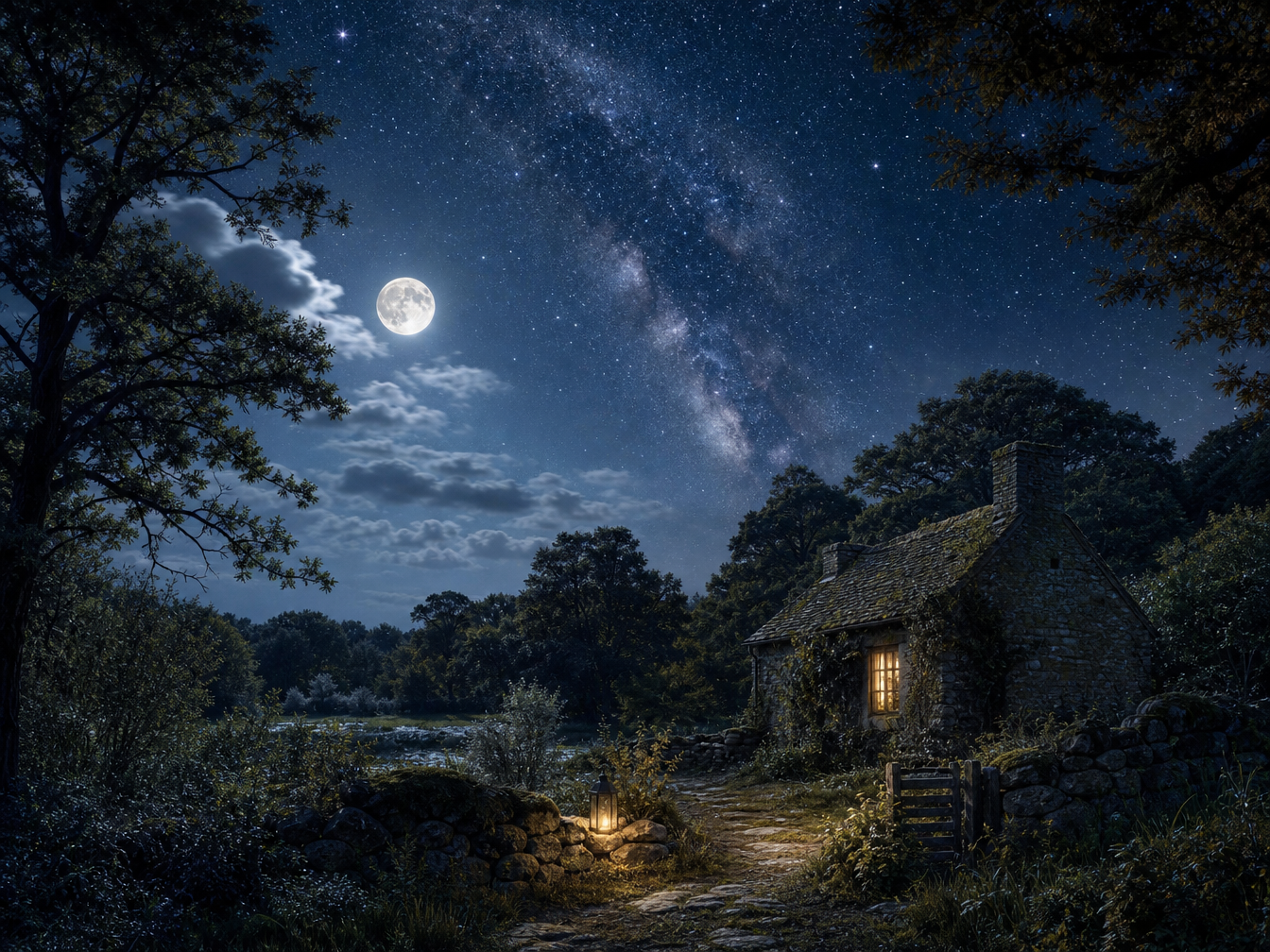
A moonlit cottage beneath a vast star-filled night sky

Moon & Sky Lore

Look up. The old stories are still there.

Moonlight, stars, twilight and weather signs have guided curious eyes for generations.

The Sky Above the Cottage

Long before clocks, weather apps and electric light, the sky was part of everyday life.

People watched the Moon to mark time, stars to find direction, cloud and colour to judge the weather, and the lengthening or shortening daylight to understand where they were in the year.

Some of that knowledge was practical. Some became folklore. Some survived simply because people kept looking up.

You do not need to understand the whole sky to begin knowing a little piece of it.

Beneath Moon and Stars

🌙 Watching the Moon

The Moon is one of the easiest things in the night sky to begin noticing.

Look for it at roughly the same time on different nights and you may find it has moved, changed shape, or disappeared altogether.

Some nights it rises while the evening is still bright. At other times it belongs to the small hours or can even be seen in daylight.

You might notice where it appears above a familiar tree, chimney or rooftop.

After a while, its movements begin to feel less random.

The Moon becomes familiar simply by being noticed.

🌒 The Changing Moon

The Moon's shape changes because we see different portions of its sunlit half as it travels around Earth.

The familiar phases are:

  • New Moon — difficult or impossible to see
  • Waxing Crescent — a growing curve of light
  • First Quarter — half illuminated
  • Waxing Gibbous — growing towards full
  • Full Moon — the face appears fully lit
  • Waning Gibbous — beginning to shrink again
  • Last Quarter — half illuminated once more
  • Waning Crescent — a narrowing curve before new

For generations, people have attached meanings, traditions and customs to these changing phases.

But there is no need to give them any meaning at all to enjoy watching them.

Sometimes the wonder is simply seeing the same cycle return again.

Names Given to the Moon

Across different places and traditions, full moons have been given seasonal names.

The names we commonly hear today come from a mixture of traditions and later popular usage, so they are best treated as evocative seasonal names rather than one single ancient calendar.

January Wolf Moon
February Snow Moon
March Worm Moon
April Pink Moon
May Flower Moon
June Strawberry Moon
July Buck Moon
August Sturgeon Moon
September Harvest Moon
October Hunter's Moon
November Beaver Moon
December Cold Moon

A Harvest Moon is traditionally the full moon occurring closest to the autumn equinox, so it does not always fall in September.

✨ Finding Familiar Stars

A sky filled with stars can look impossibly complicated.

The easiest way to begin is not to learn everything. Find one pattern.

Perhaps Orion in winter, the Plough, or a bright star you can recognise from your own garden.

Once one shape becomes familiar, other stars begin to find their places around it.

People have connected stars into pictures and stories for thousands of years. Different cultures often saw completely different figures in the same points of light.

The constellations remind us that people have always made stories from the sky.

🌌 Seasonal Skies

The night sky changes with the seasons too.

Some stars and constellations become particularly noticeable at certain times of year, while others disappear into daylight or sink below the horizon.

Orion is one of the best-known sights of Britain's winter sky.

Summer brings different patterns, and the Milky Way can become more noticeable from dark places away from artificial light.

You may also notice how differently the sky itself feels.

Winter stars can appear sharp and bright above bare branches, while summer skies may not become properly dark until very late.

Even the stars can become part of your seasonal calendar.

🌅 Between Day and Night

Some of the loveliest changes in the sky happen around sunrise and sunset.

Twilight is a threshold: not quite daylight, not quite darkness.

Colours deepen. Birds change their songs. Bats may appear. The first bright stars begin to show.

In summer, twilight seems to linger. In winter it can feel as though darkness arrives almost before the afternoon has finished.

You may find you have a favourite moment: the first star, the last strip of gold, or the instant the Moon becomes obvious against the darkening blue.

Some changes are easier to notice when we stop hurrying through them.

☁️ When the Sky Talks About Weather

Watching the sky was once an everyday way of judging what weather might be coming.

Clouds building high into towers can suggest unsettled weather.

A halo around the Moon may appear when ice crystals are present high in the atmosphere, sometimes ahead of approaching rain.

Very clear stars can accompany cold, dry nights when heat escapes rapidly from the ground.

Even the colour of sunrise and sunset found its way into old weather sayings.

None of these signs replaces a modern forecast, but watching them can reconnect us with something people once did almost without thinking.

Look up often enough and the weather begins leaving clues.
📖 Keeping Your Own Sky Lore

You do not need a telescope or an astronomy book to begin.

Try noticing the sky from one familiar place: a doorstep, bedroom window, garden, lane or park.

You might remember:

  • The first time you spot the Moon each month
  • A particularly beautiful sunset
  • The first evening you recognise Orion again
  • A halo around the Moon
  • The brightest star visible from your window
  • The time of year when evening light changes noticeably

A few notes made across a year can become your own small piece of sky lore.

Familiarity begins with returning to the same view.

🕯️ A Little Darkness is Good for Wonder

Modern nights are rarely completely dark.

Street lights, houses, shops and screens brighten places that previous generations would have known very differently.

If you have somewhere safe to do so, try standing outside for a few quiet minutes without immediately looking at a phone.

Give your eyes time to adjust.

Stars that seemed absent may slowly appear.

The world becomes quieter. Shapes change. Sounds become more noticeable.

Darkness is not empty. Sometimes it simply gives quieter things a chance to be seen.

Remember to Look Up

The sky belongs to no particular century.

The Moon above us is the same Moon watched from cottage doors, fields, ships, farms and city streets long before any of us were here.

We may understand more about it now, but understanding does not have to take away the wonder.

Notice the Moon.
Learn one star.
Watch the clouds.
Stay for the sunset.
Step outside when the night is clear.

You do not need to know everything that is above you.

Sometimes it is enough simply to look up and wonder.

✦ ✦ ✦